
Table of contents
- Introduction
- 1. Problem - State, cause, impact, result & intention
- 2. Solution
- 3. Why Web3?
- 4. Products and services
- 5. Team
- Sources
Introduction
Abstract
Throughout this paper, we would like to explain how we intend to bring structure, data aggregation, and decentralisation together, why web3 is a necessary evolution, and how three strategies will help to overcome information overload, among other issues.
For instance, all Web2 platforms have non-transparent algorithms, inflexible news feeds, and show trending topics way too often.
By structuring content and providing data in similar schemas, content becomes easier to challenge, find, and compare, thereby accelerating learning processes. (Standardisation)
Secondly, by providing tools to aggregate information and highlight findings or results, we aim to accelerate and facilitate decision-making in more distributed environments. (Aggregation)
Additionally, by decentralising the stack using smart contracts, new rules for data ownership, access, and decision-making can be facilitated, enabling P2P (Peer-to-peer) exchange and decentralisation.
We hereby propose how we aim to improve decision-making and access to data drastically by reducing barriers to crowd-wisdom, with knowledge exchange, analytics, and data aggregation.
Before reading the whitepaper, you can test the platform on ipal.network, explore content and use cases, and compare consciousness, quality and trustworthiness of exemplary content.
This living document is intended to showcase the concepts, motivation, current status, & roadmap of the project. Its sole purpose is to inform about the protocol, underlying problems, tech stack, and the value proposition.
This paper does not constitute investment advice and shall not be taken into account for any decisions.
Vision and mission
Our vision is a proactive, trusted, and decentralised ecosystem, with the aim of facilitating collaborations and improving data accessibility and content quality.
Our mission is to build a highly decentralised, multi-chain, integrable and structured system and aggregate data to speed up decision-making and empower collaborations across Web3.
1. Problem - State, cause, impact, result & intention
1.1 The state of the art
The state of the web is in constant flux, and well-known social networks, search engines, AI models, established media outlets, and prediction markets dominate today's attention and influence.
End-users are heavily influenced and often misled by these. Their attention & time are being exploited, and the establishment is profiting. The content being spread on social media platforms is inherently biased, opinionated, unstructured, or even purposefully faked to serve the intention of its creators in illustrating a potentially malicious narrative.
Specifically, social media and search engines are opaque and create so-called data-silos (i.e., a collection of isolated information that is, for the most part, inaccessible to other organisations) 1.1, consequently increasing inequality and hampering important solutions or topics that should receive more attention and visibility.
1.1.1 Search engines consume marketing budgets & your time
For instance, search engines are biased and sued regularly 1.2. A third of the top 10 search results are from advertisers, with nearly 60% of these not being transparently labelled as ads and lacking useful and applicable filters to refine a user's search. Businesses must advertise on Google's search engine to keep acquiring new clients, spending a large amount of their marketing budget to find clients for their services.
Search engines create a bidding war, hiding solutions that don't pay “enough” and using known data points about its' users to refine search output. Additionally, Google search hasn't provided any new features or filters for a while, because they would disrupt their best business model. This creates “filter bubbles”, limiting the visibility of smaller, non-paying websites 1.3. Overall, this leads to unfair, anti-competitive situations, entry barriers, and enormous amounts of time wasted searching for content.
1.1.2 The media needs to summarise on Social media to attract clients
Social media introduced a new kind of internet, connecting people and providing useful features for sharing data and building communities. However, this also resulted in data-silos and echo chambers being created. The biases, intentional fake news, and deep fakes of videos and images make it even harder to distinguish between authentic or generated, right or wrong, good or bad, and professional or entertaining content.
Entertaining content is blurring into professional advertising, clear differentiation isn't possible, and trustworthiness on all popular platforms is questionable due to AI. This has created an opportunity for new ways to advertise, because potential clients are distracted and overloaded with irrelevant aspects or news feeds.
Social media platforms won't risk their cash cow, namely the bidding war and algorithm, so information overload persists, especially since the emergence of AI, and the issues are snowballing, slowly escalating due to neglected moderation.
To stay relevant, projects & creators must innovate and be creative, by presenting funny, sarcastic or precise updates to keep loyal followers, while expanding their social circles. Constantly delivering new, exclusive, high-quality and understandable content leveraging KOLs' influence to gain attention is time and capital-intensive. But time is money and irreplaceable! Therefore, solving information overload is a huge opportunity.
As prediction markets relay key decisions like election results faster, and new so-called trust machines are being developed (further discussed in Section 4), KOLs must continue to deliver authentic & engaging content.
We believe in more modular content and pay-per-use instead of locking clients into news feeds. And the value of data for solutions, personalised AI and creativity should be undeniable.
1.2 The impact of the problem
With attention, decision-making is also largely influenced, often subconsciously, one could even say manipulated & controlled, leading to people's time and money being wasted. The damage can hardly be expressed in monetary terms, but the loss of productivity, or harm to social consensus and individuals, is definitely significant when looking at the following statistics about social media usage:
- Employees spent an average of 1.9 hours/day during work hours, up from 1.7 hours in 2023 1.4
- Usage during working hours is rarely work-related (34% for mental breaks, 27% to connect with friends and family, and 24% for professional connections) 1.5
- Employee advocacy programs have shown that 74% of marketing managers report their employees respond to >50% of engagement requests 1.6
The data silos are also increasing costs, because product margin defines how much can be spent on advertising, suggesting that sometimes not the best, highest quality product wins, but the one paying the most in the bidding war. With ~8.5 billion searches/day from over 4.9 billion users worldwide 1.7, search engines are profiting the most from the network effects combined with the bidding war.
Silos and anti-competitive practices are apparent business strategies in many professional environments, diverting attention away from small and medium enterprises (SMEs), thereby hampering innovation and fair business acumen.
Inflation is further compounding the costs associated with the infrastructure and maintenance required to keep these services operational. Countless reports show that monopolies result in continuously increasing costs for their clients and the entire society. The web3 movement is challenging these monopolies, building scalable and decentralised infrastructure to disrupt them.
Web3 companies, with even higher revenues per employee, have shown to be more efficient, philanthropic, and fair, as shown in Figure 1 below.
1.3 The intention of the ecosystem
The intention here is to attract attention and highlight why it is important and inevitable to move on and how you can personally benefit from it. We are positioning iPal as middleware and a quality source of information for communities, Web3 companies, investors & entrepreneurs venturing into the cryptosphere. By enabling fair, transparent, open, and accessible data and knowledge exchange markets, information and data become cheaper and easier to find for researchers, small & medium enterprises (SMEs), and many others. A paradigm shift has already begun, as demonstrated by countless web3 innovations like account abstraction, multi-signature wallets, blazing fast blockchains and other open-source solutions.
iPal is a web3 infrastructure project, with the aim to solve information overload primarily, by breaking up and challenging data silos at first, while working on solutions to reduce biases & improve users' search experience overall. This can be achieved by eliminating the barriers to entry, structuring, aggregating, and decentralising information and knowledge.
Moreover, we aim to address the elephant in the room, specifically the fact that nobody openly speaks about problems on social media and how centralised platforms decide what is amplified, or what is hidden. By openly embracing decentralisation & building versatile “strategic layers”, alternatives can be established through the use of incentives, structure, visual overviews and decentralisation in the following way:
- Structure - By structuring content, comment threads and providing data in similar schemas, content becomes easier to challenge, find, and use.
- Aggregation & visualisation - By enforcing structured content, while allowing the visualisation of evaluations & opinions, content can be more appealing. educative and valuable.
- Decentralisation - By decentralising the tech stack with microservices and integrations, monetisation options, as well as immutable data ownership, power can be more distributed.
This way, iPal empowers individuals or small teams to make decisions, collaborate, define pros and cons or clearly distinguish their offering. By enabling new ways to monetise, while helping clients to clearly differentiate themselves from the competition, users on iPal can:
- Reduce the advertising budget needed on other platforms and divert the attention to their website, or fairer platforms.
- Improve accessibility to information & educational comparisons, to sharpen the youth's financial & digital literacy, and divert attention and trust to iPal and web3.
- Aggregate information and create original content & data for tools that support companies' and communities' distribution, and their financial decision-making processes.
Web3 is the successor of the internet as we know it and represents a natural evolutionary step ahead. It is rapidly becoming fairer and more competitive, as detailed in Figure 1.
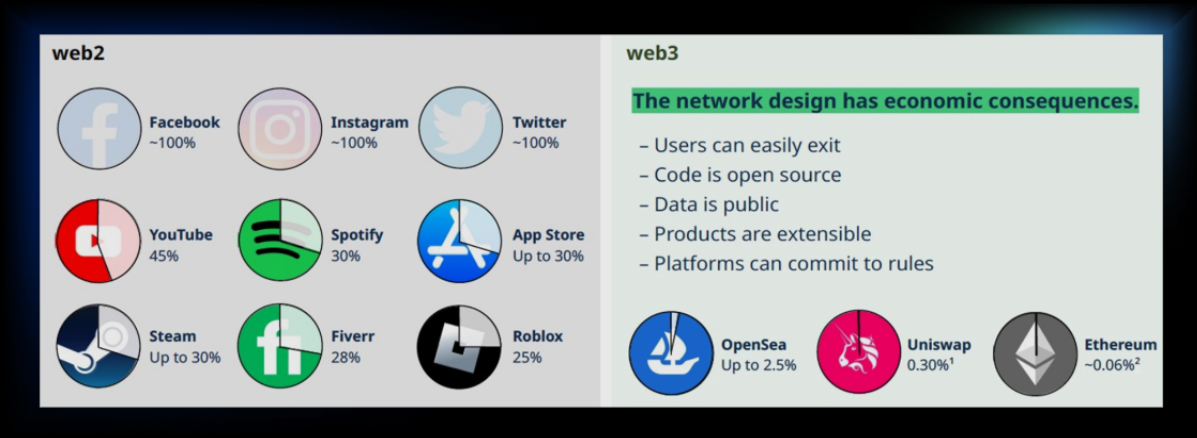
Figure 1: Incentives in web2 vs. web3 - (Source: a16z - State of Crypto report 2023)
But, Web3 infrastructure still needs to improve to ease onboarding and cater for specific project requirements. At the time of writing, there are many Ethereum Virtual Machine (EVM) Layer1 and Layer2 blockchains, and therefore, we focus on dApps for the EVM ecosystem.
1.4 Envisioned results
As a result of information overload and centralisation, many solutions of SMEs are overlooked or actively suppressed 1.2. Users' time is often monetised at the expense of their search experience. Social media introduced new, useful features, but over time, they just resulted in further fragmentation, data silos, and echo chambers.
Several reports state companies “could raise” productivity by up to 25% using social technologies. This, however, is likely neutralised by the fact that it is rarely work-related 1.2 and consumes a lot of time 1.1. Liking & supporting each other's posts, and getting informed about trends, is a common business practice to increase attention, but it can be automated, since social media is often just a company's PR megaphone 1.4.
With 8.5 billion searches per day 1.5, and assuming that an average search process or AI prompt takes 5 minutes and can become 10-20% more effective, while a white-collar or knowledge worker costs around 60$/h, productivity could be improved by around 4.25 billion $ per day globally.
Data silos and the business models facilitated by the incumbents are well protected, leading to the unavailability of filters, blocking the refinement of searching, and unlawful anti-competitive practices hampering progress 1.7.
Monopolies are very harmful to society and are unlikely to change their cash-cow business model, even when regulators are punishing them. Instead, they take the lawsuit, and business as usual continues, but they can be disrupted.
We expect new types of search engines and trust systems to emerge, as shown in Section 4, and will end this chapter with a famous quote:
"Imagination is more important than knowledge. For knowledge is limited, whereas imagination embraces the entire world, stimulating progress, giving birth to evolution."
- Albert Einstein
2. Solution
2.1 Web3 & Blockchain
A complete paradigm shift is required to solve the problems described above. In the age of digital innovation, making decisions has become harder and more complex, and the demand for reliable, transparent, and secure knowledge-sharing platforms has surged.
Current platforms like X, Reddit, as well as News outlets, slow down progress, and reportedly educational, societal, mental & financial growth are negatively impacted. High-level content and clickbait are linking to paid channels, and ever more similar stories, that sometimes still contain sponsored content.
Clients are mistreated as data suppliers, rewards are unfairly distributed, rigid subscription models hide features or data and waste time. For instance, centralised algorithms are often opaque, their weights are unclear, and most commonly tuned so that personal agendas are promoted.
Even important managers, entrepreneurs, creators, and researchers spend their precious time searching for, aggregating, or gathering information, leading to increasing costs.
Current systems, therefore, hinder progress, prioritise investors' goals over everything else.

Figure 2: Web3 enabled a complete paradigm shift
2.2 Standardisation & Decentralisation
Communities can play a vital role in disintermediating, decentralising, and increasing awareness about important topics. The rules communities commit to are also key to success. Vitalik Buterin and the Ethereum alignment rules, for instance, suggest using ETH as currency where possible, contributing to public goods or having a broader positive impact.
Open standards for interoperability and decentralisation enhance security and reduce vulnerabilities by eliminating or minimising single points of failure.
Vitalik Buterin also suggests metrics like the walkaway test and insider attack test to gauge a project's decentralisation and resilience 2.1. For long-term ecosystem growth, a modular open-source stack that can be easily integrated into other systems is best suited.
Interoperability, standards, clean code, and refactoring also play an important role when offering software solutions. Therefore, we are working on API integrations for enterprise clients, creators, and communities, and are enabling them to feature their branded knowledge vaults on iPal, which we will further explain in Section 4.1.1.
2.3 InfoFi Tools & Requirements
In recent years, many approaches to solving information overload, bias, fake news or other problems, which are increasingly critical, have emerged.
Prediction markets, which are purely based on game theory, or community notes on X.com, where X itself does not write, rate, or moderate notes unless they violate their Terms of Service, are entirely new and quite promising approaches.
According to Vitalik Buterin, “Info finance solves trust problems that people actually have,” and AI could be a participant 2.2, but it would need to be decentralised.
2.3.1 Solving biases
To identify political affiliation by classifying the headlines' “tone” and whether they are politically affiliated, Ground.news classifies news articles based on sentiment analysis. Left- or right-leaning headlines can already help to classify which media outlet is expressing certain political biases.
A title alone can often reveal political affiliation. However, information related to financial literacy, events, countries, or other topics where influence is weaponised—or where someone seeks to mislead for personal gain—requires more critical thinking.
Yet, today investigative journals, WikiLeaks.com, and other community-led or -funded projects appear to be best suited for disseminating leaked information, successfully adding incentives & reputation, rulebooks and disputes.
In our opinion, communities need to be enabled to disintermediate, decentralise, and disrupt the incumbents of an established market to sustain progress.
Ongoing analyses about “Trust machines in web3” 2.3, InfoFi platforms, and data-driven systems can be found on iPal already, and further discussed in Chapter 4.3, where we highlight other approaches. Additionally, opposing views are welcome, and the details are important.
2.3.2 Privacy, Data & System Requirements
While tracking user activities is being criticised in web3, they support data-driven decisions, and data can be beneficial in generating network effects; thus, data needs to be carefully selected, taking into account privacy and ethical concerns.
For instance, the system can track data points like knowledge vault views and which platform referred a user to iPal, while preserving privacy.
On a more decentralised platform, however, users can preserve their privacy, but they require a certain level of digital literacy, which is quickly becoming an integral part of crypto and web3. These settings can be changed quickly in centralised solutions due to new legal or business requirements, and user consent is mandatory.
However, the trustworthiness of the data is often questioned, while the governing entity isn't, including the likes and algorithms. Creating and incentivising a community to actively contribute, curate, and deter bots and scammers are major challenges that require the paradigm shift enabled by web3.
3. Why Web3?
Crypto and web3 have the potential to bring the power back to the people. People want to regain control over their finances and time online. Users are always looking for better user experience (UX), opportunities to invest with simple interactions (i.e., transparent and explainable strategies and filters) and less exposure to biased content from bots pushing certain agendas.
Ethereum Smart contracts have initiated disintermediation, while data oracles and developer tools accelerate development. The continuing wealth transfer facilitated by value-accruing cryptocurrencies & fairer incentives or airdrops has contributed to kickstarting this revolution. Technological setbacks and side effects are commonplace, like scams, fraud, or hacks, but the crypto ecosystem emerged to free people from the banking system & dictatorships.
The Ethereum and Cipherpunk alignment rules 3.1 described on the app, and the increasingly sophisticated blockchains in terms of costs and speed, have only very recently facilitated mainstream applications to emerge.
More importantly, the alignment to build composable software across the ecosystem accelerates solving challenges such as proof-of-personhood, which aims to identify bots, scams, or biased content. Many solutions reducing biases, improving communication, democratising the dashboards needed for quick decisions, and facilitating data aggregation are being analysed on iPal.
The platform is built on decentralised infrastructure and provides fair and diverse options to monetise, advertise and generate leads in web3 and beyond. These primary goals align with the industry because Web3 facilitates accountable, transparent, and privacy-preserving digital products.
3.1 Common Values & Rules
Web3 stands for trust through decentralisation, an evolution of the internet, reward-driven communities and incentives like no other movement, which is well worth promoting and defending.
Whether or not we can blindly trust LLMs and their very own biases, depending on the provider, is a challenging question. But if AI systems with full accountability, transparency, & personalisation can emerge, they must be governed, without exposure to critical opinions or intentions.
We believe that truly purpose-driven, digital societies can thrive and need to be powerful & influential. To accomplish this, reducing silos, entry barriers, paywalls, and costs is required, as well as better reward systems and data-driven mechanisms.
The future of web3 is bright and enabled by unstoppable technology that needs governance, common values and rules to thrive.
3.2 Features & integrability for global collaboration
At first, communities, creators, researchers, & entrepreneurs can launch pay-per-use models for knowledge databases. To cater to a global audience, we opted for a web-based app that can translate the tables into any language, for end-users to collaborate in their native language.
An easily extensible, robust, and stable web3 dApp infrastructure allows our network to add new components, processes, and integrations. With the following steps, we aim to further decentralise the monetisation, data, role management & account layers, and enable others to collaborate globally:
- Build a monetisation and payment layer and further democratise it, for instance, by reducing the fee linearly when specific milestones are achieved.
- Enable data-driven approaches to facilitate fair rewards, and continue building a composable, modular platform with open-source components.
- Allow automation and use or deploy smart contract-based workflows.
- Develop and use standards like multi-sig, account abstraction, etc.
- Implement rigorous user and role management on-chain, add sybil resistance mechanisms, and implement a transparent scoring system.
The following image will help to understand how monetisation and access management have been implemented in the smart contract.
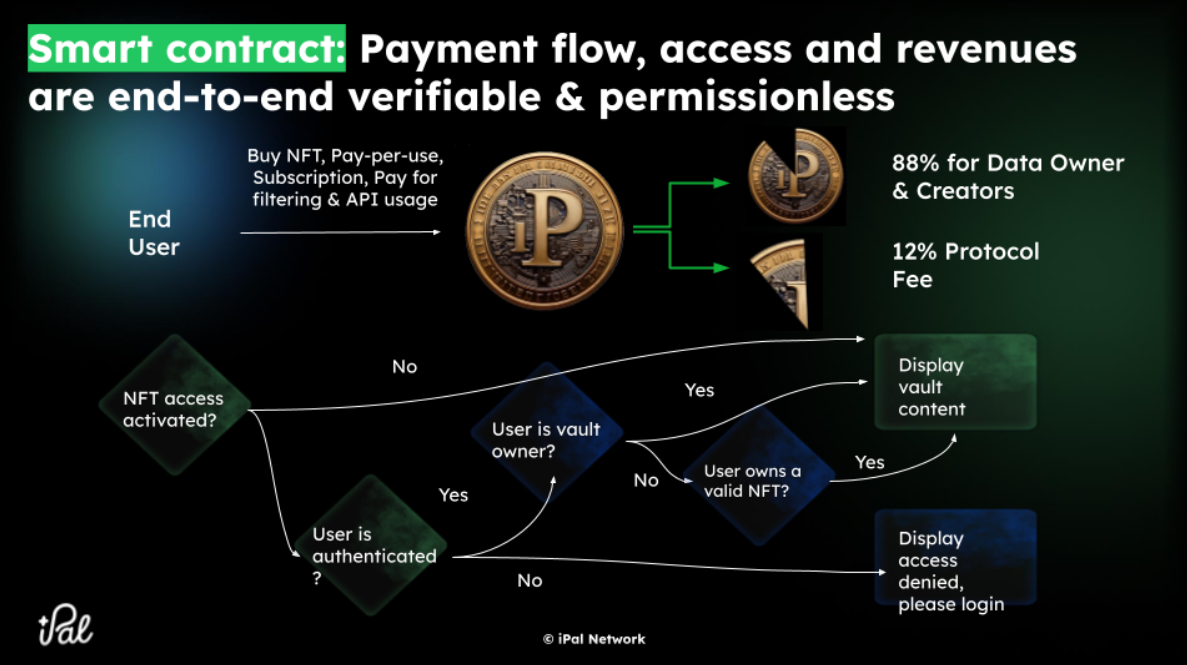
Figure 3: Fully decentralised access and monetisation workflow, & initial in-app fee distribution
3.3 Composable, Adaptable & Modular Design
In Web3, it is common to build integrable, adaptable, and modular solutions to enable further innovation.
iPal is cloud agnostic and hosted on a decentralised cloud, allowing us to deploy servers anonymously with established providers using cryptocurrency payments. Containers and Dockerisation also enable us to work with other Decentralised Physical Infrastructure networks (DePIN) and, for instance, share bandwidth, compute or storage resources.
The tech stack is intended to enable creators, researchers, and entrepreneurs primarily, while it allows users to stay entirely anonymous, because they might share something they can't or are afraid to say in public.
3.4 Sybil Resistance & KYC
Decentralised identities leveraging KYC (Know Your Customer) processes, while allowing every individual to apply only once, can increase accountability.
Imagine you have only one chance to be a “good” social media user and are having trouble re-joining.
Creating a new profile with a high proof-of-personhood score is already very time-consuming today and will become harder with well-placed cryptographic systems.
Therefore, we have implemented a score already, and will continuously gather data about users' activities to steer internal processes.
3.5 Interoperability
Globally available systems will likely have to be adapted, hosted in different countries, and follow various rules. In this case, we simply have to limit liability with strict terms of service, and can't appeal to every eventuality in every jurisdiction from the beginning.
While there could be an arbitrator, or counsel, or we could token-gate specific datasets or information, we can only plan for specific scenarios, or make the stack more configurable.
Figure 4 visualises the stakeholders and adaptability of the first implementation; it should also be used to improve the understanding of what can be changed quickly.

Figure 4: Cloud agnostic and interoperable tech stack enabled by Base & Gnosis Safe
4. Products and services
The network's success also depends on its users' financial health. We believe that our users should be enabled to make decisions and profit from them.
Therefore, building or incentivising work on systems and processes around the platform to create flywheels and automated mechanisms, as well as increasing exposure on other social media platforms, is essential for iPal. This will include carefully selecting integrations, open-source systems or protocols, and indicators like scores, views, likes, and content related to the “strategic layers” mentioned in chapter 1.3.
In our opinion, we need to use or build better decision-making tools and communicate transparently.
For instance, when to publish our entire code base, how to modularise it to allow integrations or dApps to build with iPal, how to carefully select developers to contribute, and secretly working on new tools could set new standards for decentralised governance already.
At a later stage, these processes can become standard practice and integral parts of distributed and decentralised systems.
4.1 Build Strategic elements
Strategically, we will focus on building new features, incentivise the creation of informative content and facilitate new ways to monetise content using various cryptocurrencies.
Of course, we also intend to provide integrations like a customisable white-labelled solution for sensitive and confidential data. This solution will provide them with the latest data or version of the tool for enterprise processes.
Additionally, all public knowledge vaults created by clients and hosted on their websites (i.e. with iFrames) can also appear on iPal.network if desired.
Serving clients & communities while building a treasury on iPal will enable a stable incentives system. Moreover, verified and diligently audited partners will be incentivised to curate and adhere to content quality standards set by the community.
4.1.1 Use & Build API Integrations
Facilitating new ways to distribute development workload, more features, settings and stable interfaces, as well as our scores and found-and-built strategy, represent strategic building blocks for the network.
Widely applied systems like the “Open Graph protocol” are used to highlight the content elsewhere with branded banners, titles and descriptions when sharing a link to iPal, and many other features have already been implemented.
A simple browser extension, for instance, could notify our users that better-structured & peer-reviewed content or more detailed comparisons are available on iPal.
To reduce information overload, we can present data in many apps, and from various viewpoints, or aggregate data, add scores, apply structure and standards (criteria, search filters, etc.), visualise it in compelling diagrams (or colours reflecting opinions or pro-contra arguments), & decentralise the underlying technology stack.
Therefore, integrability, accountability, governance and transparency are built in by design, and are all intended to make building new dApps using our stack or trustworthy data a breeze.
4.1.2 Build Layers, Trust, Scores & Data Pipelines
Authentications and credentials are the foundations upon which access is granted, a job is awarded, or credit is extended. Depending on the outcome, these can be beneficial or unfair, life-changing, devastating, or even save lives. Even though decisions are among the most important things in life, many decisive factors determining our lives tomorrow are influenced by web2 monopolies today.
Today's web2 players are gatekeeping credibility, manipulating their users with algorithms, intransparency, fake privacy or pseudo-anonymity, and unverified users aren't even flagged, labelled or evaluated, and thereby everyone is being deceived. Additionally, users deliberately hand over the power to social media companies, including the power over credible entrepreneurs. But these accounts (influences), essentially megaphones, are often insufficiently protected (with passwords), and get hacked 4.1 (or later claimed to have been hacked to avoid punishment).
We need to develop, combine, and provide workflows, tools and assurance, so that creators cannot be hacked, blocked, or blackmailed, and conversely can be punished for manipulating others. Authentication systems need to allow immutable anonymity when best practices are followed, and ownership or other checkpoints must be bulletproof for continuous progress.
1. We need to build and promote better, free, and permissionless authentication systems
The authentication used directly impacts ownership and control. Web2 social media platforms own everything, including the license to use your content, and your account that they can revoke at any time, but they are not safeguarding your data well enough. Weak passwords are likely the worst security mechanism we currently use on the internet. The login mechanisms of centralised companies could become even more vulnerable - for instance, to quantum computers, while blockchains are already upgrading their systems to be quantum-proof 4.11. Additionally, 71% of hackers leverage social engineering attacks, essentially, impersonating users 4.2. Content is hardly curated anymore, which can cause serious harm since posts and accounts can be manipulated and deleted 4.3.
The Facebook marketplace has over 50% market share, creates over three billion buyer-seller connections every month and over 62% have encountered scams or fraud 4.4. We conclude that, especially when money is involved, scammers find ways to deceive. Centralised companies protect themselves and their data with very long, frequently updated terms of service, and often obscure the finer details about privacy and personal data. Lawsuits are continuously filed, involving lawyers in constant legal battles due to these unfair terms, in drafting new term sheets, or litigating between two parties. Eventually, this led to cumbersome logins and authentication processes, long and obscure fine print, nerve-racking cookies and trackers. We need more open, transparent systems under decentralised control to increase accountability & improve UX, among other KPIs.
2. We need to invent better ways to check & safeguard users' accounts, data and scores
Verifying users, distinguishing between bots and real users is important to safeguard users' interests. Thus, accounts should belong to users irrevocably; they serve the need to make users adhere to certain rules, like confidentiality. We can reduce the exposure of everyone's data in a single data breach and make the open internet a place to own, earn, and learn again. Web3 is a movement that has only recently shown relevance for real-world applications.
The internet needs to evolve like every other technology. While KOLs can take advantage of their current position, get more rewarded than others, they need to stay up-to-date & avoid promoting scams. Reviewing projects, content before publication, collaborating, and performing deep research anonymously (if needed) could be integral for the safety and prosperity of Web3.
3. We need to continuously improve the configurability of all layers
As mentioned above, our monetisation and payment layer, data-driven approach, automation and security, and user management need to be continuously improved. The problems in particular that have been hard to solve by web2 competitors are security, data risks, and fairness in general, because they are all "moving targets". Solving these requires a lot of flexibility, settings, and fallback solutions in web2, whereas in web3, a token economy could present a viable solution.
For instance, by law, it is allowed to summarise content 4.5, but there are limits and edge cases when it is accessible without authentication 4.6. There used to be a fine line between fair use and getting sued, but LLM and AI webscrapers gather data unethically and without the consent of the original content creator. The proliferation of bots on the web requires adding a new layer of trust, also for anonymous profiles. Therefore, the web3 industry, which has been acknowledging that problem long before ChatGPT stole everyone's work, has developed more open standards (ERC-1155 Account abstraction) to abstract and aggregate information.
All aspects mentioned in this section increased our conviction to build more open, accessible, transparent and collaborative environments, and inspired our found-and-build strategy.
4.1.3 Found-and-built strategy
Incentives, legal advice, as well as secure data and processes, will drive our efforts to incubate and speed up joint ventures or product launches.
Some challenges above have moving targets. Therefore, flexibility is key, which tokens and incentive models can provide. Many software components developed are open-source, because the laws often lag behind. When “code is law”, and the underlying code and smart contracts are the definitive authority and new laws like the EU Data Act 4.7 are put in place, then systems already developed may not comply, or be allowed to be published in the view of regulators.
Data, code, and intellectual property need to be protected, and any violations need to be enforced by law or code.
If IP rights can't protect from scrapers or the governments cannot enforce their own laws [1.6], and we cannot count on the competitors or users' ethics, the network needs to be fast, secure distribution channels, maintain financial health, and secure the interests of the community.
Therefore, we are actively advising other Founders, incubating projects, and publishing content for a variety of readers and especially entrepreneurs.
4.2 Facilitate Use Cases & Flywheels
The platform's features are intended to facilitate real-world use cases. New ideas submitted by members, and datasets driving adoption, can kick off new flywheels and will be rewarded. While data, information and advertising workflows can be useful for many use cases & industries, the core team will focus on crypto and AI-related content, build new workflows, and use mainstream social media platforms, raiding tools, etc.
Flywheels often lead to network effects, and when those are large enough, new opportunities, dependencies, or even monopolies emerge.
To remain an open, accessible culture and become a value-accruing network, we suggest becoming a community-owned DAO. We are already gathering data for incentive mechanisms, and will release more information at a later stage, due to reasons explained above in section 3.4 Sybil resistance & KYC.
Many systems, like oracles, forums with long-term incentives and smart contract-defined rules, or trading platforms, RWA or AI agents for investment solutions, remain to be built or need to improve, for which reason we decided to continue building infrastructure and facilitating these.
4.3 Create AI Agent Infrastructure
While AI holds incredible potential for productivity, the risks for misuse are also unquestionable [4.8]. Bad actors can spread misinformation, which has had negative impacts on the progress of all 17 UN SDG Goals.
Newswashing is becoming increasingly popular, misinformation is causing harm globally [4.9], and “No one should be at the mercy of an algorithm they don't control, which was not designed to safeguard their interests” (Antonio Guterres, UN General Secretary). The algorithms are becoming increasingly biased, and "openly accessible" AI models are perpetuating the company's interests.
Due to the risk that AI will “make the web toxic for its successors” [4.10], creative, legitimate & original human-created content needs to be more appreciated or identifiable as such.
Therefore, we believe that human-generated content and traceability, like data provenance checks and real DIDs (digital Identities), are essential to improve AI-generated outputs. Having actual control over system prompts and your data, to get a more personal or even the best possible response with secure and end-to-end verifiable systems, is currently a utopia. Such advanced systems would have to be carefully fed with structured, curated data and ingest personal preferences.
We would argue that consensus mechanisms, which are not used (yet), collaboration and game theory will be required, and decision-making has to improve first. For this purpose, comparison could answer questions you didn't even know you had, colours can subconsciously show how important, good or bad something really is, and experts with scores can add weight.
The emergence of “trust machines” like prediction markets introduced direct incentives and optimistic oracles to create a new forecasting tool. The recent strategic investment of ICE, the mother company of NASDAQ, highlights the growing interest in the sector [4.12].
An ongoing analysis on iPal about forecasting tools, including scoring systems and opinion markets, highlights, for instance, the risks & real-world applications [2.3] concludes that all generate more or less “useful data” and could feed data into LLMs and move markets.
While AI agents can be very useful execution tools, but require constant retraining, supervision, updated data, and oversight. In the future, everyone should have an AI agent, owned, controlled and working for themselves. Examples of useful platforms to find promising agents, evaluate them or build one can be found under ipal.eth, and we will release more content, templates and guidelines about building AI agents, & infrastructure needed to make them more decentralised.
5. Team
Our interdisciplinary team has been working on AI and crypto trading since 2020. Due to the fact that the world is getting more and more opaque, siloed, centralised, and unfair, a strategic decision has led to the creation of this Web3 infrastructure project by the 3 Co-Founders.
Lukas Meilhammer (LinkedIn) has a degree in Aerospace Engineering, worked for Airbus, and has been specialising in AI and Blockchain since 2017. He is a serial entrepreneur, writer, data strategy consultant, and market analyst. Since then, Lukas has become an advocate of activism and enabling technology, as well as decentralisation and privacy. Lukas founded Eagle AI in 2017, grew and maintained a cross-industry network, and built several AI prototypes, companies, and Open-source projects from the ground up, while managing human resources, capital, client negotiations, business strategy, and operations.
Velitchko Filipov (LinkedIn), is a data scientist and researcher and holds a PhD from the Vienna University of Technology. He is a Full-Stack developer specialising in Data Analytics, visualisation, AI, and UI/UX. He has extensive experience in the integration of graph databases, application development, deployment & testing. Velitchko has an academic track record and has published several research papers in highly prestigious journals about data science and visualisation with a focus on dynamic network visualisation and analysis. Over the past 8 years, he has gained experience with database security, decentralisation, and cryptography as well.
Maury Jesus Teixeira (LinkedIn) is a Full-stack developer and seasoned Front-end dev, building complex and robust prototypes on decentralised clouds. He has an entrepreneurial, strategic, and pragmatic mindset, and knows how to maintain, deploy and fix code. His experience across Python, JavaScript, Typescript, and Linux systems, as well as his passion for tech, laid the foundations for iPal. He has a master's in Data Science and experience in AI and crypto trading, and has been working on this venture with Velitchko and Lukas since July 2022.
6. Tokenomics & Fees
These initial tokenomics are subject to future changes. We hereby explain the existing smart contract, mechanisms used and examples that can shape the proposals in the future.
For more information about the technical mechanisms, we created a technical White Paper [6.1] and a user manual on Notion [6.2] to provide frequently updated docs.
In this chapter, we address the need for tokenomics and the ongoing discussion around incentives, ownership and power.
Tokenomics & utility explained
Literally every technology has undergone significant changes, and there is no reason to believe that the internet, the cornerstone of our society, will stop improving.
The promises of Web3 have been promoted for years, and the necessary infrastructure for mainstream adoption has recently emerged. Common values and rules, as discussed in Section 3.1, must be followed, and transparent tokenomics must be implemented for balanced ecosystem growth and incentives.
Initially, the protocol collects the fees, and there is no token involved yet, as outlined below. Figure 5 shall be understood as the initial protocol, and the fee collector that is subject to changes and additions.
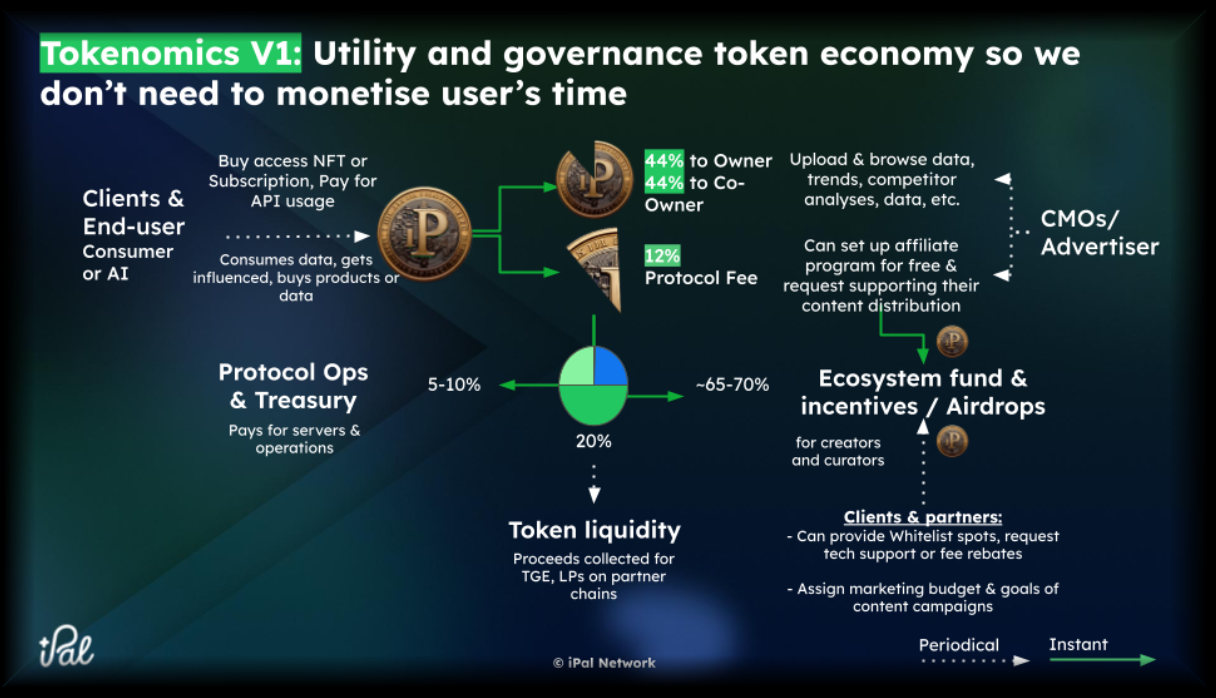
Figure 5 - Tokenomics Version 1 - Utility and governance token
Fee distribution & usage
The smart contract on iPal distributes 88% of the revenues vault owners generate directly to the owner and their collaborators, and the protocol fees are 12% sent to our multi-sig wallet. A token economic system needs to increase clarity in the underlying operation of the protocol as early as possible, decentralise the development and decision-making processes, & reduce centralised attack vectors.
We hereby want to suggest a token economy that can be implemented, or added to an existing ecosystem, with zero additional downside risk, adding utility to the token in the long term.
For instance, an ecosystem could utilise an existing token or launch a new token and upgrade it with the following utility and advantages:
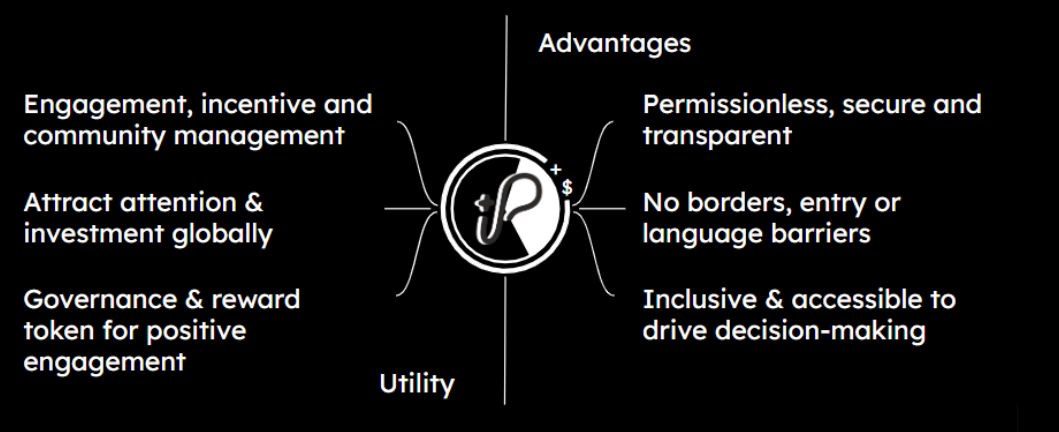
Figure 6: Token utility we can add to any existing ecosystem via our found and built strategy
We suggest that tokenomics and utility are designed with specialised tools, and should aim to make the protocol decentralised in the end.
For instance, incentives and airdrops for UATs (User acceptance tests), early creators and curators and other necessary vehicles need to be defined in the beginning, and updated by a governance proposal later.
In any case, governance and utility tokens can be utilised to promote engagement, like creating lists, liking content on social media, or other activities in the community's interest, like evaluating or curating important subjects or topics.
Hereby, we would like to provide some examples of how a token can be utilised in general:
| Token utility | Description |
|---|---|
| Reduce centralisation and facilitate more and more decentralised decision-making | The larger the impact and power of a network becomes, the higher its responsibilities, and risks of being corrupted, economically attacked, or hacked. Critical attack vectors can be reduced by reducing centralised single points of failure, designing and encouraging positive engagement |
| Controlled incentivisation mechanism | Similar to encouraging engagement, community incentivisation for ideas, fee generation, referrals and more can be better controlled with a capped, & deflationary token of our own. These airdrops can be vested, more sustainable, and distributed over a long period that will be defined in 1 Year. |
| Attract investors, decision-makers & attention | Token created to attract investors' attention and used to fund the protocol's early development & operation, encourage engagement and skin in the game. |
| Balances and limits access to scarce resources (like features, investment allocation $$ or license to incubate projects) | There are more features in the pipeline, that can turn data and signals into investment opportunities, trading or new tools. Artificial scarcity of accessing such tools could be materializing with a token holder tier in an early phase, and increase attention and support. |
| Incubated projects need to lock the token and create LPs | To ensure a constant demand for an ecosystem token, projects building on Top of iPal can get discounts on subscriptions for increasing their exposure to an iPal ecosystem token, e.g. by launching LPs on DEXs further increasing attention due to new pairs appearing (e.g $XYZ/$IPAL) |
Figure 7: Example of a Token's utility in an ecosystem
7. Roadmap
The iPal network started as an algo trading firm and became a network of entrepreneurs in 2022, with the aim of enabling open-source collaboration and structured discussions, decision-making, and knowledge management.
We came across new methods to secure data with web3 technologies, and are anticipating that confidential computing can disrupt existing data silos, and are sure that LLMs and entirely autonomous workflows need better data, oversight, and governance.
We are builders, data scientists, and entrepreneurs who have discovered new ways to share or monetise content & data together. Then, we built a versatile no-code solution, launched a private Beta test and included privacy features, comment threads, and other features, only to find out that we should rather reduce entry barriers in such a fast-moving space.
So we revamped in Sept 2024 to build a new PoC in about 6 months, ran a private beta test, and laid a better foundation for more secure dApps.
Especially when smart contracts and systems automation are involved, bugs can appear and remain unnoticed, and attack vectors are being exploited in an unforeseeable way.
Therefore, it is almost impossible to execute plans without deviating from the original path. The following roadmap shall be understood as is, and is subject to changes.
| Q3/25 | Q4/25 | Q1/26 | Q2/26 | Q3/26 | Q4/26 |
|---|---|---|---|---|---|
| Expand advertising offering, attend Web3 events and build connections with communities | Support the best partners and communities & Develop own distribution channels | Add features, an API, and integrations to connect other platforms and services | Offer custom integrations for enterprises (in web3 and beyond) | Focus on developer communities, integrations & Partner with distribution channels | Develop more Open-source or MCP-System components |
| Smart contract launch Litepaper release | Focus on the community's ideas and the first joint- venture | First TGE and reward system | - Implement basic governance - MCP (Model context protocol) | - Launch first proposals - First treasury allocation | Further decentralise the governance |
Sources
[1.1] IBM — What are data silos?
[1.2] Thomas Hoeppner — LinkedIn
[1.3] Taylor Herzlich — NY Post — Google search shows bias to major brands, pushes hidden ads
[1.4] Electroiq — Social Media At Workplace Statistics By Usage, Income Level And Time Spent
[1.5] Zive — Why enterprise search will finally achieve a breakthrough
[1.6] Demandsage — How Many Google Searches Per Day (Latest 2025 Data)
[1.7] Reuters — Google loses fight against $2.7 billion EU antitrust fine
[2.1] Vitalik Buterin — limo.eth — Alignment
[2.2] Vitalik Buterin — limo.eth — Infofinance
[2.3] Trust machines in Web3 — iPal
[3.1] Lukki.eth — The Ethereum and Cipherpunk alignment rules
[4.1] Medium — iPal.network — Social Media is breaking records
[4.2] Profiletree.com — Revealing the Unnerving Social Media Hacking Statistics for 2024
[4.3] Coffeezilla — Argentina's Memecoin Disaster Is Worse Than You Think (YouTube)
[4.4] Cropink — 37+ Facebook Marketplace Statistics Every Marketer Should Know in 2025
[4.5] Nolo.com — Fair Use: When Copyrighted Material Can Be Used Without Permission
[4.6] Wikipedia — hiQ vs. LinkedIn
[4.7] European Commission — EU Data Act
[4.8] McKinsey — The economic potential of generative AI: The next productivity frontier
[4.9] Antonio Guterres — cited by Vatican News — “The proliferation of hate and lies in the digital space...”
[4.10] Ben Dickinson — ChatGPT model collapse
[4.11] Vitalik Buterin — limo.eth — Futures
[4.12] X (Twitter) — [Shayne Coplan (CEO, Polymarket)][https://x.com/shayne_coplan/status/1975534265698812046]
[6.1] iPal Docs
[6.2] Notion — iPal User Manual